Wednesday, May 19, 2021

The Last Post

This Blog has moved.

Postcards From Across the Pond is still active, but is now in a new location. You can visit it at:

https://pcfatp.com

If you want to continue receiving post via email, please do this:

  • Put your email address in the “Enter your email address” box.
  • Click the SUBSCRIBE button.

That’s it. You will continue to receive posts via email.

Thanks, and I hope to see you over there,

Mike

Saturday, May 15, 2021

Moving

No, we’re not upping sticks and heading to Corfu to become beach bums (though that doesn’t sound a bad idea), I’m merely moving my blog from its current home at Blogger to new digs at WordPress. I’ve done this before, twice in fact, so it feels a bit like re-marrying your ex-wife, divorcing her again, then marrying her for a third time, which is certainly a case of optimism triumphing over experience.

When and why I switched from Blogger to WordPress and back again isn’t important, and to tell the truth, I barely remember when and the why was because they kept pissing me off. Seems I was a bit excitable in my younger years. I have more equanimity these days, and there are other mitigating factors that should make this move permanent.

Mainly, I have all my other blogs there. Somehow, I managed to acquire a boondoggle of blogs (boondoggle is the collective noun for blogs) and all of them are with WordPress, so this is akin to re-marrying your ex for the second time, and then having a couple of kids to hold you together. Also, I know what I’m getting into. WordPress is shit, but having created and maintained other blogs with it, I am getting used to how shitty it is and have since made peace with it. And lastly, Blogger—which had a wonderfully intuitive interface and lots of nifty widgets—decided the WordPress method was better, and turned their interface to shit.

Even so, that, in itself, did not tempt me to move. I was used to working with WordPress’s shitty interface, so the WordPress-imitation shitty interface Blogger inflicted on its users wasn’t much of a problem. It was the Feedburner. Feedburner is a Google-based widget that allows fans of a blog to enter their email address and, thereafter, receive new posts to their IN box, which is handy for sporadically updated blogs like mine. It’s been working, and collecting emails, for so long that I had forgotten all about it, until I received a notice from Google the other day telling me they were going to “improve my experience” by stopping the service. I hunted for a replacement, but there were none to be found. Oh, there were plenty of similar products that touted a variety of bells and whistles I didn't’ want or need—for a fee—so the doorway to that option closed, especially when Blogger confirmed that they had no intention of replacing the Google FeedBurner with one of their own.


So, there was no point in keeping my blog at Blogger any longer, except for the 368 posts dating back to 2006. That’s a lot of history, and I was loath to leave it behind, but then I discovered you could export your blog and import it into WordPress.

Pardon me for being sceptical, but, yeah, right.

With that thought in mind, and not much hope, I initiated the process. To my utter amazement, it worked. All of my past posts, along with comments and photos, appeared in the new WordPress blog. There were a few formatting issues with the old posts, but I am more than willing to overlook that.

The final niggle was the URL — pcfatp.com — which was initially bought via Blogger, who was then taken over by Google, who then sub-contracted it out to GoDaddy, meaning I had to spend half a day tracking down the URL and getting it released to WordPress. Allegedly, this is done, and I’ve paid for it; I’m just waiting for it to take effect, which should have happened by the time you read this. This will allow anyone who accesses my blog via that URL to do nothing, and still find my blog. As for those of you receiving updates by email, I’m afraid you’ve got some admin ahead of you.

If you want to continue receiving post via email, please do this:

  • Go to: https://postcardsfromacrossthepond.com/ — this will put you on the WordPress blog, if you are not already there.
  • Go to this widget:

  • Put your email address in the “Enter your email address” box.
  • Click the SUBSCRIBE button.

That’s it. You will continue to receive posts via email.

If, on the other hand, you are someone who signed up long ago for reasons you don’t remember and now wish you had not, just do nothing. The posts will soon stop arriving in your IN Box.


In case you are interested: One of my moves to WordPress came about when I was advised that, if you wanted people to take you seriously, you had to have a WordPress blog--or, at least, not a Blogger blog. This was a good lessen in not listening to unsolicited advice from well-meaning people.
The random example above shows the Archive widget. The one on the left is from the WordPress blog, which I pay a not insubstantial amount of dosh for and could not look less professional if I had cobbled it up myself. The elegant, easily navigated one on the right is from the FREE, unprofessional-looking Blogger blog.
That said, WordPress does have good customer service. Although, that's probably because they need it.

Sunday, April 25, 2021

A Man Walks into a Pub

Last Friday I went to my April Book Club meeting. I haven’t talked about Book Club on this blog because, well, the first rule of Book Club…

Anyway, this month was The Hearts Invisible Furies by John Boyne, and if you haven’t read it, you should. I warn you, about halfway through I was tempted to fling the book across the room because the main character did something I couldn’t abide, and I lost all respect for him. If that happens to you, I encourage you to persevere. You’ll thank me. If, on the other hand, it doesn’t bother you at all, you’ll have to make your own peace with that.

But that’s not important. I want to talk about how I got there.

It was a lovely, sunny day, and the pubs had recently begun serving again (outside only) so we no longer had to meet over Zoom and were, instead, meeting at The Greet Inn in Warnham, about two and a half miles from my flat, so I thought I’d walk.

A lovely day for a walk.

The first half mile of the mini-trek—from my flat to the Nature Reserve—is the worst bit, so it was good to get it over with up front. The road is busy and getting busier and, if the Council has their way, will become busier yet. But it didn’t take me long to reach the relative quiet of the Nature Reserve and the peace and tranquillity of the golf course just beyond.

The golf course was lovely, expansive, green and serene, with a path running along the verge—well away from the danger of flying golf balls—near the bank of the Arun River. The only niggle was the knowledge that the Council is planning to concrete it over and cram it full of cheap, substandard housing, so they and their cronies can line their pockets. The residents of the town are raising an almighty hoo-hah over this proposal, but the Council has a history of ignoring residential hoo-hahs, especially when there is money to be made.

What the golf course looks      What it the Council wants it
like now.                                    to look like

But those were thoughts for another day. I ushered them aside and concentrated on enjoying the nature that was there now. I followed the trail around a crystal lake (a big pond, really) and found myself on the trail to the underpass that would lead me to the other side of the ultra-busy A24, where Warnham was. The sun was very warm by now, the air was still, the birds were chirping, and it was ever so peaceful. I could just about—

“ARMED POLICE!!!!”

Put your hands up and drop your liberal, bunny-hugger opinions!

I’ve been watching a lot of Line of Duty so I know what that means. I was so shocked I didn’t even think to raise my hands, something that, in America, would have seen me shot on the spot. Instead, I looked behind me, expecting to see a dozen black-clad swat-cops leaping from the undergrowth, pointing laser-guided assault weapons at me. And I couldn’t imagine why.

Had I committed some unknown offense? Perhaps I had crossed the golf course without having donned the requisite style of clownish golf trousers. Or maybe they were Government agents, sent to stop me from making any more cynical references to the clown in Number 10. Or perhaps it was something closer to home, the Council sensing that I was enjoying the golf course for what it was, instead of gleefully imagining it covered in Soviet-style architecture.

Clownish Golfer                         Clownish Tosser

Nothing, however, happened. Then there was the unmistakable sound of a door being bashed in and the yelling and shouting one generally associates with a forced entry (told you I’ve been watching too much Line of Duty). That’s when I realized it was my phone.

Somehow, my phone, in my shirt pocket, had turned itself on, opened my news-feed, navigated to a story about a police raid and started the video accompanying said article. I’m not sure I could do that myself, so I can’t understand how my phone did it all by itself.

I didn’t stop to ponder this, I was just relieved I wasn’t being hustled into a police van.

The remainder of the walk continued without incident. I wasn’t even mugged by a deer when I followed the footpath through a deer park. And deer can be fairly cranky.

I arrived at the pub and—after being indoctrinated on which door to enter by, leave by and never, under any circumstances, touch, and where to sit and how to order and what to do about the bill and the procedure for registering my visit with the NHS Track and Trace System —was served a pint of beer. (Up until then, it never occurred to me how much admin a pandemic requires.)

Nearly there.

At my table, just at the edge of the outdoor seating area, the sun shone on my back, the birds chirped soothingly in the background and around me was the gentle hum of conversation. I lifted the pint of Harvey’s—the first I had enjoyed in many a month—and took a sip. It was soothing, satisfying, and serene.

But I checked to make sure my phone was turned off, just in case.

Serenity at last.


Saturday, March 20, 2021

1984 – 37 Years Later

In 1980, I bought a paperback version of 1984, figuring I should read it before the fateful year arrived. Forty-one years later, I’m still carrying that book around and I still have not read it. But this week, I finally picked it up and managed to move beyond its famous opening line:

“It was a bright cold day in April and the clocks were striking 13…”

I’m well into the narrative now and I’m finding it unsettling. I think, if I had read it when I meant to, I might have taken it as a warning of what the world might become. But reading it now, in 2021, I have to acknowledge that most of what Orwell predicted has already come true. And the irony is, we didn’t need a malevolent government to force us into doing those things, we are willingly, and with unbounded alacrity, doing them to ourselves. The government couldn’t stop us if they tried.

The book was written when television was in its infancy, yet Orwell imagined we would have huge screens in our homes, broadcasting propaganda 24-7. It seemed fantastical, impossible, even, but here we are, with 120-inch, Ultra HD Smart TVs in homes, tuned to Fox News or CNN, so they can tell us what to think and to shout our opinions back at us all day and all night.

And we don’t need the Government to mandate the daily Two-Minute Hate, we do that to ourselves—for hours a day—doom-scrolling our Social Media information teat in order to keep our indignation boiling.

In Orwell’s book, the big screen in your home—in addition to telling you what to think—watches and listens to you, and there are microphones hidden around in the outside world to further track your movements and conversations. While most TVs currently can’t hear what you are saying, Alexa, Echo, Siri and Google Home can. And your phone keeps excellent tabs on you—and listens to your conversations—even when you aren’t voluntarily broadcasting your location and activities to the world at large, sometimes with tragic results.


Bill Gates doesn’t need to inject you with a micro-chip so he can track you (spoiler alert: he isn’t), your mobile phone is doing a much better job.

In Orwell’s dystopia, the government forces all these intrusions on the population. In our current society, we buy them ourselves and gleefully integrate them into our lives.

We don’t even need the Thought Police, as we have an army of volunteers who continually patrol the borders of their shattered self-esteem, looking for ways to become offended and, when they find a Tweet or FaceBook post (might be current, but it could be something from long ago) they start a Twit-Storm to make sure that the person who offended them loses their job and is shamed off of social media. That’s as close to being vaporized—the 1984 euphemism for being totally erased from history and society—as you can get without actually employing an army of IT hackers and Blackshirts.

And Winston’s job at the Ministry of Truth wouldn’t be a paid position. Altering the past has become an avocation for weekend culture-warriors. Pulling down statues, banning books, outlawing toys and censoring people (via the aforementioned Twit-Storms) because of a past they’d rather not acknowledge is accomplished by enthusiastic amateurs, not government agents. Additionally, people have been known to alter past writings to make it seem as if they had predicted something when they had not. (I’m looking at you, Dominic Cummings.)

In 1984, the Government wanted you to believe 2+2=5. In 2017, the government wanted you to believe that an inauguration crowd that wasn’t there, did, in reality, exist. And we were encouraged to support this fantasy by believing in “alternate facts.” And many did, voluntarily and without the threat of incarceration. (I do wonder, however, how many people believed that the President of the United States could change the course of a hurricane simply by drawing lines with a Sharpie pen.)

Big Brother, 1984: 2+2=5
Big Brother, 2017: The crowd on the right is bigger

As you can see, the hurricane is heading for Alabama...

But, despite all this voluntary assistance, the government isn’t asleep at the wheel. They are working hard to curtail the right to protest, and are pushing laws through that make it possible to be arrested simply for holding an unpopular opinion. Not far-out-batshit-crazy opinions, either. All you have to do is say something—anything—that another person claims offends them, and you have broken the law. And critics of the new Scottish Hate-Crime Bill, fear it leaves the door open for people to be arrested merely for expressing unorthodox views even in the privacy of their own homes.

1984? It didn’t happen then, but it’s here now.

Watch out for Room One-Oh-One.


 "If you want a vision of the future, imagine a boot 
stamping on a human face- forever."

-- George Orwell, 1984


No boot on face, but this is a photo of Metropolitan City Police London violently restraining a woman at a peaceful vigil, which was not a protest but a peaceful coming together of women, to highlight violence against women and to mourn the death of Sarah Everard who was kidnapped and murdered by a serving Metropolitan Police Officer, occurring on the eve of a bill being introduced to Parliament that will substantially increase the power of police to disperse (violently, one must assume) pretty much anyone at any time for any reason, and you couldn’t fit more irony into a sentence if you tried.


Wednesday, February 10, 2021

By the Numbers

All of my working life, I had a dream: when I retired, I was going to take up painting. It was a dream that sustained me through many long years of gainful employment, thinking about what I could accomplish once I no longer needed to earn a living.

And so, one happy day, I retired, and my dream immediately foundered on the rocky shores of reality. Not only did I lack the time, I also found myself bereft of talent, or any noticeable desire. After all those years, it turns out I didn’t really want to paint a picture. My feelings about art, instead, mirrored those of the many who say, “When I retire, I’m going to write a novel,” which is to say, I wanted to have painted a picture.

Many happy years have come and gone since then, and my determination to not paint has served me well. Painting takes up space, and the more you do it, the more space it takes up. We might live in a small flat, but no amount of writing is going to fill up my tiny office the way even a casual interest in acrylics might.

However, shit—as they say—happens, which, in this case, takes the form of Lockdown Number Three. Being shut up inside for six weeks and counting (again) had me looking around for some additional diversion. For Christmas, my wife had given me, as a sort of joke, a dot-to-dot book for adults (not to be confused with Adult Dot-to-Dot; Google carefully) and I found that to be a soothing diversion. So, when I finished it, I looked around for something to fill the time it used to take up and, somehow, I came to the notion that there ought to be paint-by-number sets for adults (not to be confused with Adult Paint-by-Numbers; Google carefully) and, sure enough, there are. (Suggested motto: Paint-by-Numbers, because real art is hard.)

Be careful how you Google.

Having memories of the paint-by-number sets of my youth, I was slightly skeptical, but these new, more mature sets, really tick the boxes. They are not, as I feared, the rigid,10x12 inch boards that I remember. These are 16x20 inch canvases that come rolled up, along with little plastic containers of the necessary paint, and three brushes. They take up little room and, when you are done, you can toss the whole thing in the bin.

That is the best bit. You don’t have to worry about where you are going to hang your masterpiece because, when you finish, you’re more likely to find that your efforts look less like the Mona Lisa and more like someone tied paint brushes to a terror of toddlers (that is the collective noun for toddlers, isn’t it?) and let them roll around on the canvas. But the point isn’t the finished product, it’s the zen-time spent dabbing paint on a brush and trying to stay inside the lines. You can do that perfectly (spoiler alert: you won’t) and you’ll still end up with something you really should hide away somewhere.

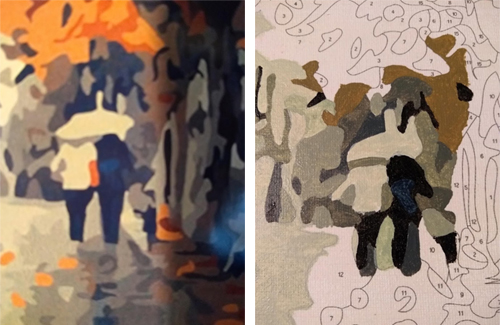
The problem is the way they are made, which is also the great thing about them. The canvases are printed by a computer program that scans a real painting, recognizes color and pattern and translates it onto a canvas. As with many automated tasks, however, the outcome is only as good as the software, and sometimes this translates to an overcast sky you are instructed to paint lime-green, or distant objects that disappear. The upside is, this makes these sets inexpensive enough that you won’t mind chucking them out (or at least rolling them up and stuffing them behind a bookcase) when you finish.

What the detail in the picture looks like          what the detail on the canvas looks like

Admittedly, my experience is limited. I’m only on my second picture and both have come from the same company. There may be others that have better software but, as I’ve noted above, that is hardly the point.

Even so, when I order more, I may go with another, more expensive, company to see if there is an upgraded version of the software that might render a picture more accurately. But until then, I’m content painting my skies green, and doing what I can to fill in the gaps.

So if, like me, you find yourself at a loose end this lockdown, you could do worse than try a paint-by-numbers kit. Unless, of course, you are really working on that novel.

Hmm, I wonder if the world is ready for a novel-by-numbers kit.


Thursday, January 14, 2021

You Learn Something New Every Day

I have decided that 2021 is the year to put that bit of folk wisdom to the test. The challenge, however, is not merely in the learning.

For example: on the first day, I learned that scenes from the 1947 film Black Narcissus were filmed at Leonardslee Gardens, which is just down the road from where we live. This gave me unexpected delight and prompted me to begin this year-long odyssey.

The second day, I learned something, then forgot what it was. Later, through great mental effort, I managed to recall it. Then I forgot it again. So, that day, I learned that I cannot rely on my short-term memory.

And this is what I believe the benefits of the exercise will be, the simple act of remaining open to new knowledge and experiences and committing them to memory (and then to a spreadsheet; I have no illusions about my ability to retain 365 tidbits of esoteric information for instant recall).

Over this year, I hope to gather a mix of surprising facts along with learned skills. I do not count things I simply found out, such as, “I just checked my Twitter feed, and it turns out Jason is a right Muppet.” No, it would have to be a more uplifting bit of actual knowledge, such as the fact that when you climb Mt. Everest, you are required to return with a load of at least 30 pounds, consisting of your shit, anyone else’s shit you run across, and other miscellany you find strewn about. This is to help with the effort to keep Everest shit-free and de-cluttered. If you fail to do this, you forfeit your $4,000 deposit. I feel I’m a better person for knowing that.

The trick to this, as well as the benefit, is simply remembering what you did learn. Many lessons come to us every day, but they are often lost in the maelstrom of daily life, so I find being continually on the lookout for something that may enriched my knowledge base helps me look forward to the day. And on that note, I originally thought that 2021 might be the worst year to attempt such a thing, seeing as how there is very little stimulation at the moment, but then I realized this is the optimum time, because it not only helps you appreciate the slower pace of life, but it reaffirms the notion that you are always learning, no matter what else might (or might not) be going on.

Such as: despite common belief, only 4% of the content on the Internet is porn. Don’t ask me how I know this.

I do wish I had more skills on the list, such as “Learned to play Edelweiss on the piano” (alas, I have not) but, so far, all I can claim to have learned is that, if I just stuff my jeans into the socks I wear with my wellies, it feels fine.( I had been neatly wrapping my jeans around my ankles and carefully pulling the socks over them. This took time and the result always caused a pressure point on my ankle. Just pulling them on saves time and doesn’t end up annoying me on the walk.) It’s a little thing, but it does add to my quality of life.

Not everything does, however. I also learned that there is such a thing as a Vampire Finch. It’s a variety of finch (duh) that lives on a remote volcanic island. They are too small to get off (they likely got there on the winds of a storm) and there is nothing for them to eat so they survive by drinking the blood of the other sea birds there. The strangest thing is, the sea birds don’t seem to mind. This still gives me nightmares.

The Vampire Finch, the stuff of nightmares.

Although this has enhanced my knowledge, it is not as beneficial as this nugget: When one computer in your home is used to buy something, or even browse something, all other Internet-connected devices in your home—phones, laptops, tablets, the microwave—will get ads for that item in their FB feed or on Google. This is because all of them share the same IP address, which is associated with the router, not the individual devices. And that really is handy to know. (See the 4% item above.)

Some items are multi-faceted, allowing you to learn several things at once. Such as this historical oddity: The unique typeface of Dove press, after an acrimonious court battle, was destroyed by one of the owners (Thomas Cobden-Sanders) who secretly threw the punches into the Thames over the course of several months, in late 1916 and early 1917. (The reason this took so long is that the total weight of the punches was 2,600 lbs—this wasn't digital type.) 100 years later, Robert Green, who was working on a project to recreate the typeface, hunted for, and located 150 pieces.

Some of the recovered Dove Typeface.

This is fascinating, not only from the archaeological angle, but the fact that anyone cares enough about a typeface to go through all that, and that, back in the day, a typeface was not to be taken lightly (see what I did there?). They were carved and moulded and cast in metal and were worth enough that it caused the two men who developed this one to fall out over the money.

While admittedly enlightening, the above is not as potentially useful as the fact that it is perfectly legal to buy and possess a flamethrower in forty-nine of the fifty states (Maryland is the only state where you cannot).

The photo was stolen from an article titled:
You can buy a flamethrower online, and it's legal

My most recent acquisition, however, has proved to be—thus far—the most useful, because it put to rest something that has been on my mind of late.

I’m over here, gathering my information about world events through my media of choice. I think they are good choices, I think they tell me enough of the truth to allow me to make my mind up about what I believe. And I think I’m right. But there are others, who have their own information streams and who also think they are right. They think they are right as strongly as I do. So, who is right? I truly did wonder about this, but then I discovered a way to tell: If you are unsure about which side you're on, next time you are at a gathering of your group, look around. Do you see Nazis? If so, then you are on the wrong side.

The final benefit of this undertaking is: despite all that is going on in the world, I am looking forward to finding out what each new day can teach me. It’s a good way to get through the year, even if I never do learn to play Edelweiss on the piano.


Thursday, December 31, 2020

A Dangerous Year of Reading

This past year may have been one huge cluster-fuck of bad news, but one of the good things to come out of it was I had a lot of time to read. So much so, that I have finished 2020 having read more books than ever before (I have a spreadsheet; of course I do). The not-so-great news is, even with all this reading time, I still only managed to finish 44 books, which tops my current record by a slim margin of 1, leaving me, in equal measure, pleased and chagrined. Additionally, and in the spirit of full disclosure, I must admit that, when I saw I was closing in on my erstwhile record, I cheated a bit by selecting two rather slender volumes, the last of which I finished only this afternoon.

Still, an ugly win is still a win, and perhaps this will encourage me to try harder next year.

I am, you see, not a very fast reader. I have friends who can finish a book in a day (at least they tell me they can; I’ve never actually seen them do it) whereas I spend up to a fortnight on your average murder-mystery. What I found helpful, especially in my rush to ram as many books as possible into these final weeks of December, is a quota of pages per day, and I discovered something rather remarkable about it.

If you accept the notion that the average book is around 350 to 400 pages long, all you need to do is decide the number of books you want to complete in a year and read that many pages every day. (e.g. 1 page a day will get you 365 pages, or a single book, 2 pages, two books, etc. You’re welcome.) It helps if you develop a reading habit, such as devoting your lunch hour to reading while you scarf down your tuna-and-mayo sandwich, or reading before bed, or carrying a book with you everywhere you go so you can fill the downtime by reading instead of staring at the back of the person in front of you in the queue. (Ebooks work great for this, as do audio-books.)

In his book, A Year of Reading Dangerously, Andy Miller states that he decided on 50 pages a day and, subsequently, read 50 books. (I didn’t read his book, by the way; my wife did, and told me about it.) In addition to a scattering of popular titles, such as Catch-22, Lord of the Flies, The Da Vinci Code and The Tiger Who Came to Tea, Miller also tackled the types of books people claim to have read but actually haven’t, including Don Quixote, The Epic of Gilgamesh, The Communist Manifesto, Beowulf, Jane Eyre, War and Peace, Middlemarch, Frankenstein and that bane of every American English Lit student, Moby Dick.

My list for the current year is shorter, less ambitious but, quite likely, more entertaining:

I admit to gravitating toward popular fiction, and murder, mayhem and madness in particular, therefore, the Jack Reacher books of Lee Child are on my Guilty Pleasures List. Unfortunately, Mr. Child has recently retired, so that particular stream has dried up. I had also been enjoying the books of Edward Marston (Keith Miles), but I’m afraid that has soured for me, as well.

Mr. Marston is, if nothing else, prolific. His historical thrillers—set in the 1850s, 1100s, WWI, et al—are fast-paced and superficially interesting, but also read like a first draft turned in by a talented 16-year-old. I used to be able to get beyond that, and take delight in the fact that I could point out things I would never do (like have two characters sitting in a room telling each other things they already know simply to get the information to the reader; simple, Writing 101 stuff) and thereby feel that I was a superior writer. But the fact that he has published nearly 100 books and has been nominated for an Edgar Award sorta puts a damper on that bit of fun.

As a substitute, I have discovered the books of Elly Griffiths, and I recommend reading anything with her name on it.

In addition to low-brow lit, I also read some non-genre fiction, thanks to the book club I belong to. This year, these included:

  • Bluebird, Bluebird by Attica Locke, a murder mystery set in the south. I recommend it.
  • Warlight by Michael Ondaatje, cold war shenanigans, really interesting.
  • The Snakes by Sadie Jones, good book, ruined by the final chapter. Don’t bother.
  • The Ballroom by Anna Hope, love in a prison. Recommended.
  • Wanderers by Chuck Wendig, a weighty but highly recommend tome about (gulp) a pandemic. Must read!
  • The Midnight Library by Matt Haigg, quirky, very entertaining, and short.
  • My Sister, the Serial Killer by Oyinkan Braithwaite, ditto.
  • Girl, Woman, Other by Bernardine Evaristo, really quirky and not as short, but I still recommend it.
  • How to Fall in Love With a Man Who Lives Under a Bush by Emmy Abrahamson. The title says it all. It’s fun, entertaining and short.

Books I highly recommend are:

  • A Tree Grows in Brooklyn by Betty Smith. If you have not read this book, go out, buy a copy and read it now.
  • His Dark Materials, a trilogy by Philip Pullman. Stunning in scope and imagery.

Books I do not recommend:

  • Black Eyed Susans by Julia Heaberlin. Prominently displayed at my local bookshop and heralded as a great read. It was anything but.
  • Lockdown by Peter May. He wrote this years ago and his publishers passed on it but, when the real lockdown happened, they pulled it out of mothballs and hyped the shit out of it. I read it, and now I know why his publishers passed on it. Utter rubbish. Read Wanderers instead.

And I would be remiss if I didn’t mention the books by Catherine Ryan Howard. Rewind and The Nothing Man were both good books and Ms Howard is gaining traction as an upcoming talent. Keep an eye on her, and buy her books.

That is my reading year in review. I wish you all a Happy New Year and hope you enjoy many good books in the months to come.

I’ve got my spreadsheet ready for 2021, with 45 empty slots for the books I’m going to read, as long as I can fit in 45 pages a day.


Monday, December 21, 2020

An Early Christmas Present


 “Ask about getting a Shingles vaccine,” my wife says, as I prepare to leave for my flu jab.

Shingles? Isn’t that some medieval affliction, like cholera, typhoid fever, or the Black Death, and similarly consigned to the fringes of society? She assures me it is not, and is, furthermore, something I do not want to have.

And so, I ask the needle nurse about getting a Shingles vaccine. She tells me I won’t be eligible until I am 70. I am comfortable with that. I have never given Shingles a thought, and was certainly not planning on contracting it, so I tell her I will ask again in five years’ time.

Then I went home and got Shingles.

This caused great consternation, for two reasons. First, it is jolly uncomfortable, but more on that in a bit. Secondly, and initially more concerning, was this: for the past ten months I’ve been masked, sanitized, distanced, and going through bars of disinfectant soap like a wino through boxed Lambrusco (in a “gone as soon as it’s open” sort of way, not actual consumption), so how did this malady evade all those defences? And, more to the point, what else might get through? (I’m looking at you, COVID.) 

My fears were quelled, however, when I learned that one does not “catch” Shingles. Apparently, I’ve been carrying this around with me, like unwanted baggage, for some 63 years, ever since I had Chicken Pox. The virus, Dr. Google informed me, has lain dormant all that time, waiting for a chance to strike.

I blame my wife.

I’ve been happily going about my business with this sleeping virus inside me, not causing a bit of bother, until she pipes up and starts talking about it. I’m certain the virus perked up its ears when it heard her mention “Shingles” and thought, “Someone’s calling! Time to get to work!”

That’s my version and I’m sticking with it because there is no way I would have done this to myself.

It began innocently enough. Just a patch of tender skin, slightly tingly, like someone had rubbed it vigorously with extra-fine sandpaper. I dismissed it, but my wife put on her concerned face.

The next day, it had spread over the right side of my torso and my wife pronounced it to be Shingles. I dismissed it.

The next day, the rash appeared. My wife managed to avoid saying, “I told you so,” and I consulted Dr. Google.

I was advised to call the non-emergency health number (111). So, I did. I explained my symptoms to the person who answered the phone (they said they were a Doctor, but you never know; he could have found the gig via the Job Centre and took it because it was a step up from Loft Insulation cold-calling) and they told me to call my local GP. So, I did. There, at least, I was told up front that the person I would be talking to was not a doctor, but to spill all the gory details anyway, because that’s what they were there for.

I told the lady I had Shingles and she replied (literally, I am not making this up), “What do you expect us to do about it?”

Taken aback, I said, “Well, nothing, really. I checked your website. It said to call 111. I did. They said to call you. So, I am. I’m just ticking boxes. I have Shingles. If it gets worse, I’ll call back. Okay?”

She was happy with that, and I was certain the disease was already at its zenith and did my best to forget about it. Then I spent the next four days in bed, unable to move.

I know I must have, at some point in my life, experience more pain and discomfort than I have from Shingles, but I struggle to recall when that might have been. It was so excruciating and supremely uncomfortable that it was impossible to stand, or even sit. All I could do was lie in bed and pop paracetamol like a Ketamine junkie. Even breathing was painful.

Further research informed me that Shingles lasts from three to six weeks and that, sometimes, the rash and blisters go away, but the pain doesn’t. It can, Dr. Google affirms, last weeks, months, or even years.

Thrilling.

However, despite all this, given the choice between COVID, the flu or Shingles, I’d take Singles any day, mainly because its list of common outcomes does not include “death.” (I have since learned that you can, indeed, die from an extreme case of Shingles, but in much the same way that you can die from an extreme case of Stubbed Toe.)

At any rate, after a few days, the pain subsided to a point I would call “Manageable,” which allows me to get up and go about my business in a manner I would describe as nearly normal but involving more paracetamol and lengthy naps. If the malady follows its normal course, I can expect to enjoy it over Christmas and have its company as I ring in the New Year. I can only hope it is well and truly gone before my birthday.

I didn’t include any pictures on purpose. If you really want to see what it looks like, consult Dr. Google. I don’t advise this, however; some of those graphics are horrific.

In a way, now that I have Shingles, it seems like it was meant to be. What better way to end 2020 than with yet another unwelcomed calamity?

I hope your Christmas is as festive as it can be under these circumstances. And if you are ever offered a Shingles vaccine, take it.


Tuesday, November 10, 2020

Lockdown 2.0

I ended my first Lockdown Diary on 18 July, and posted to this blog about it. The post ended with a mocked-up photo of my fictional, future Lockdown #2 diary. I don’t recall thinking that it would really happen, but here we are.

Lockdown 2.0 isn’t much like Lockdown version 1, however. In fact, if I didn’t know a lockdown was in progress, I might not even notice. (That, however, would mostly be down to me being so unobservant.)

The traffic is lively, but lighter, if you notice those sorts of things. Many shops are closed—the hairdressers, pubs, restaurants—and we can’t go to the leisure centre, the cinema or the bookstore, and, although my wife can still work with her volunteer group in the park, it is now in pairs instead of groups of six.

Traffic, Lockdown version 1

Traffic, Lockdown 2.0

On the other hand, we can still go out as much as we want. There is no “one hour a day” restriction, and when we walk through town we can still shop at the markets, go to the mall and even get a cup of tea, though it is take-out only.

I realize that, like the first lockdown, many, many people have been adversely affected but, also like the first lockdown, we are in the very fortunate position to not be one of them. And because of that, to me, this seems more like Lockdown Lite than Lockdown 2.0.

And as a bonus, there isn’t any panic-buying going on, and there is a lot less angst. This isn’t our first rodeo, so we know what to expect; the virus is no longer an unknown bogey-man, the hospitals are better at treating it and, even without the continual prompting, we all know what to do (wash your hands, wear a mask, don’t French-kiss random strangers) even if we don’t always do it.

Town Centre, Lockdown version 1

In a way, this lockdown takes me back to those heady days of early summer when Lockdown version 1 was letting up—the ragged queues for take-out coffee, paying attention to the masking tape on the pavement, feeling like you’ve made a significant accomplishment when you finally step up to order, and mentally high-fiving yourself when a shop you need to go to is actually open. It’s a strangely nostalgic feeling, associated with freedom and hope.

Town Centre, Lockdown 2.0

The final difference is, this one is finite. Unlike the rolling three-week extensions of Lockdown version 1, Lockdown 2.0 is set to automatically expire* on the 2nd of December, and when it does, some/most/all of us will get back to the “normal” we were experiencing before. Which raises an interesting question: if we leave these restrictions and return to what we had come to know as normal life, does that mean things are back to Normal?

Perhaps this has been the Government’s strategy all along.


*I know the Government hasn’t had a stellar run of kept promises, but they really mean to stick to this one. No, really, they do. They won’t U-Turn on this one, they promised.


Thursday, October 29, 2020

Strange Coincidence

Long ago, in the Before Time — before Breixt, before Trump, before COVID — I began writing a fantasy/adventure series for my grandsons. Any dedicated reader of Postcards… will be aware of this, as I keep banging on about it. Previously, however, I have only talked in general about the series; today I am going to mention something quite specific.

The series involves Arthurian legend and a stone—an obsidian Scrying Mirror called the Talisman—that holds the power to save the Land or, in the wrong hands, destroy it. The good thing about writing fantasy (something I had never envisioned doing) is that you can make shit up. So, I did.

The Talisman gets its power from Brighid (an actual goddess, supposedly, the origin of the goddess Britannia) and becomes even more powerful when placed in the Sacred Temple hidden deep beneath the Glastonbury Tor.

Of course.

The Tor is a place imbued with mystery, which made it the ideal location to hide a sacred temple. But how does one get at that Temple? What I came up with was the idea of a big, round stone, set into the side of the tor. The stone would mark the entrance to the underground temple and, to open the gateway, they had to…but that would be telling. What I can tell you is, I arbitrarily set it on the south side at the 5th level, simply to make it hard to get to as well as to avoid having it at the top, a location where there is, quite obviously, no large, round stone.

Earlier this year, while writing the final book, I needed to take another look at the Tor to help set up a scene, so I fired up Google Maps, as I have done countless times in the past. This time, however, I noticed something new: a location indicator pointing to something called the Egg Stone. A quick check revealed that this was the stone I had been writing about all along, without even knowing it was there.


The Egg Stone (said by some to be the “Dragon Egg” laid out by the Dragon of Avalon) has been there probably as long as the tor, and over the years has become mythologized as the gateway to the underworld, which is exactly what it is in my books. Even more coincidentally, it is in the same location as the stone in my books—the south side, on the 5th level.

It was a weird feeling, discovering that the fictional stone I had been writing about for eight years actually existed. I felt I needed to go see it in person so, on a lovely, sunny day in September—while my wife and I were on holiday in Somerset—we made a side trip to the Tor.

Level 5 on the South Side

We walked to the top, enjoyed the views, and then I set off to find the Egg Stone. It wasn’t difficult locating it—I’ve known exactly where it sits for years—but getting to it wasn’t easy, which is how it is in the books. I scrambled up a nearly vertical slope, dodging sure-footed sheep, prickly bushes and stingy nettles, to find it as I imagined, nestled in the slope rising from the fifth level. I was really chuffed, but there was no one to share my moment with. Then a woman came down the slope, wearing sandals, a psychedelic tee-shirt and glittery harem pants. She descended to the level ground and gave me no notice, even when I greeted her. Instead, she placed her hands on the Egg Stone and just sort of stood there, touching it.

The Egg Stone, right where I said it would be.

I figured that must be the thing to do, so I joined her, placing both my hands on the rock, but I didn’t feel anything, just cold stone and a rising embarrassment. Having achieved my goal, I left her to it, not bothering to say, “Good-bye” as I left.

Good thing, too, as I later found this review of the Egg Stone:

“A very peaceful and very spiritual place. I wouldn't disrespect it by taking photos. The best way is to go and experience it quietly and respectfully.”

So, I was a New Age Boor because I did both. But then she didn’t feature it in a fantasy/adventure epic, so I guess we’re even.


Sunday, October 18, 2020

Holiday II

We’ve just returned from holiday and, as usual, it already feels like we never left. There is laundry to be done, dishes to wash, and it seems that no one did the hoovering while we were gone.

Wait a minute! That’s the same thing I wrote last month. It’s like deja vu all over again.

But the truth is, we went on holiday. Again. This time up north, to Yorkshire, where we enjoyed the “atmospheric” (Read: clouds, rain and wind) scenery, which truly was stunning.

Scenic though it was, and even though we hiked and drove repeatedly thought the Moors (in various states of weather), I managed to take not a single photo of the breath-taking vistas. So, here’s one I nicked off the web. It’s better than anything I could do and, as a bonus, it’s not raining.

One of the highlights of the trip was a ride on the North Yorkshire Moors Heritage Railway. I’m not really a train buff, but it was certainly interesting and quite an experience.


Getting ready to board.

It's a steam train, what did you expect?

This is what it looked like when we went through a tunnel.
Must have given those Victoria couples quite the opportunity.


For you trainspotters, here's the engine.

The train brought us to the town of Whitby, a place famous for its Jet jewellery. It was a lovely town and we had a nose around, then dried out in a convivial café to wait for the train to leave and marvel at how the locals kept their famous Jet so well under cover.

We also went to Scarborough and, yes, the fair was in town. I think it’s always there.

Parsley, sage, rosemary and thyme...

Here's the beach. And this was one of the better days.

On the way back from one of our excursions, the SatNav decided to take us on an adventure, leading us onto narrower and narrower roads, up and down near-vertical inclines and over what they call a “Splash,” which is a road that runs under a creek instead of over it; a circumstance, one must suppose, reserved for those hamlets that lack the funds, ability or ambition necessary for building a bridge.

Makes you wonder how they get to the shops after a heavy rain.

Oddly, the most exciting thing we did on holiday was listen to the news. Every evening we sat, giving the flat-screen affixed to the wall our full attention, as region after region fell under the juggernaut of COVID. One by one, the surrounding counties fell, like used face-masks, by the wayside, but the county of North Yorkshire remained resolutely in Tier 1, as did our home county of Sussex.

It might not have been such an exciting sideshow, but the Government (bless them) managed to keep everyone on their toes through obfuscation, random rule-changing and offering us the opportunity to realize the sad, yet frightening, truth that they, themselves, had no idea what they were doing.

That particular week, they came up with a sort of Maslow’s Hierarchy of Need for the COVID era, with a Tier System ranging from One to Three, as opposed to the traffic light system they came up with a few weeks back that went from Green to Red. Same number of levels, same meanings, same confusion.

The new Tier System.

The idea that we might be locked down in North Yorkshire and unable to leave or, worse yet, locked out of Sussex and unable to return, or perhaps be required to drive a circuitous route home to avoid locked-down counties, gave a little extra spark to our otherwise peaceful holiday.

As it turned out, we were able to leave North Yorkshire while it was still in the Green (I mean, at Tier 1) and were not required to avoid driving through any counties on the route home (fortunately, we were nowhere near Wales) and we arrived to the Sussex we left, which, though still in Tier 1, is slowly, politely, climbing the ladder—as is the rest of the country—toward Tier 2, and beyond.

Good thing we had a holiday when we could. We won’t be going anywhere else for a long time.